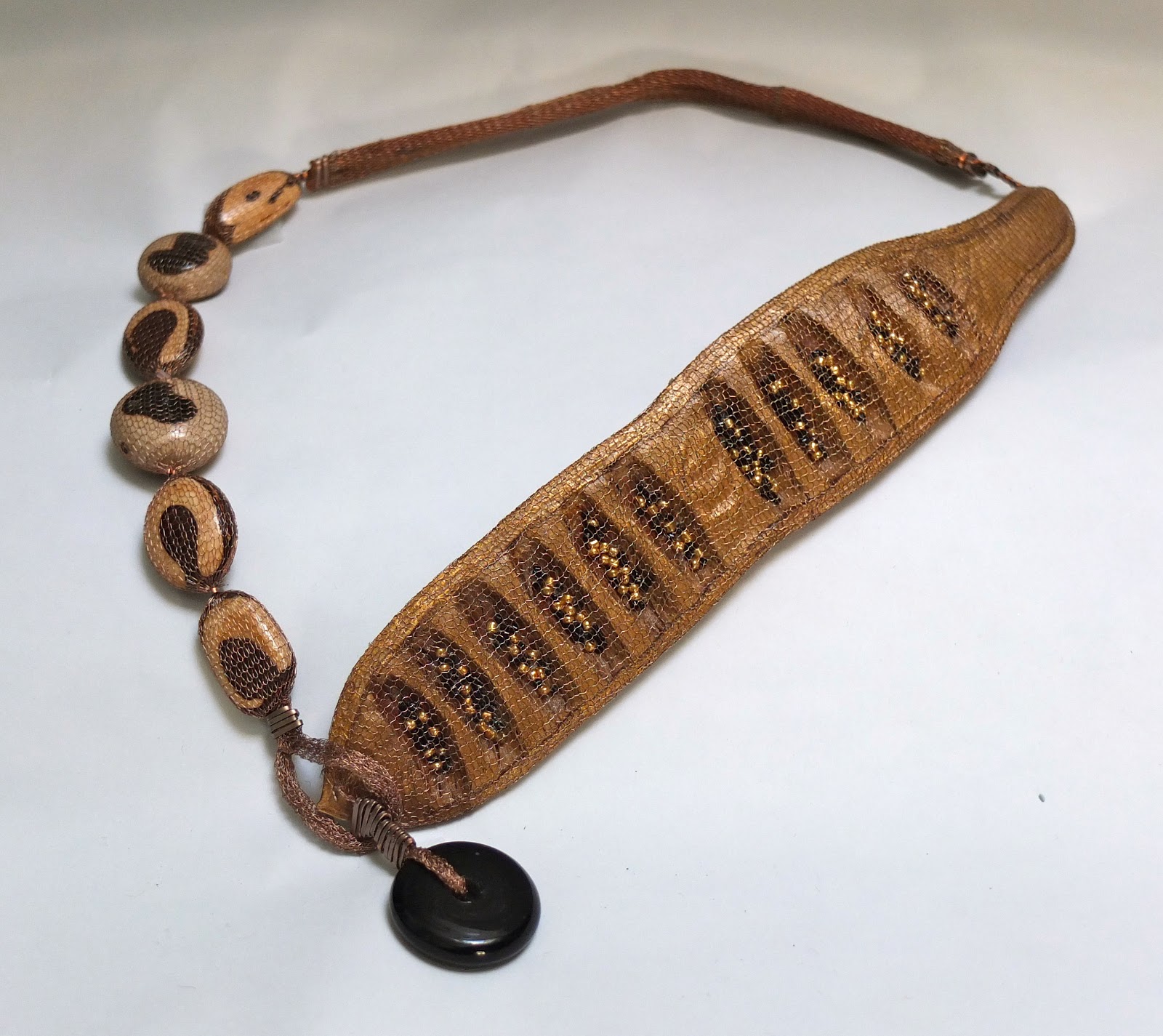
I've returned to my original idea of a cuff based on the decorative arches of the Accademia building which is in the background of Canaletto's painting. The arches now have a mirror image .
The joints will be covered by thin metal strips, with metal cross-ties holding the top of the lower arches in position. The cross-ties pick up the cross pattern just below the roof edge of the building.
Here's a first test of the metal strips to see how they look.
I first thought of using silver (in an ideal world) but I like the contrast of the copper's colour - although that will tarnish, of course. So I'll try it with aluminium, too.
I keep coming across connections and crossovers between different art forms. My alarm tone is from Acid Brass (which I discovered through the film Four Lions) and in my research for Transformation happened on Jeremy Deller's involvement:
Acid Brass was a musical collaboration between Turner-Prize-winning
artist Jeremy Deller
and the Williams
Fairey Brass Band. The project was based on fusing the music of a
traditional brass band
with acid house and Detroit techno.
Acid Brass began in 1997 as a
collaboration between Deller, the Stockport-based Fairey
Brass Band and Rodney Newton who created all the brass arrangements. Deller saw
a connection between the two apparently disparate genres, viewing them as
"two authentic forms of folk art rooted in specific communities". The
music has since been taken all over the world, and was performed by the Fairey
Band before a London crowd of 25000 in July 2005.
In 1997, The KLF co-founder Bill Drummond heard Acid
Brass performing The KLF's "What Time Is
Love?" as part of their encore. Consequently, Acid Brass
collaborated with The KLF (appearing in their alternative personae as The
Justified Ancients of Mu-Mu) on a track titled "Fuck the Millennium",
incorporating Acid Brass' cover of "What Time Is Love?". The track
was released as a single under the moniker 2K.
The track "The Groove that won't
stop" was played over the end titles to the 2010 movie "Four Lions".
I wish I hadn't missed his exhibition at the Hayward.
This is not working for me. Looks like what it is - a collection of rubbish!
But ... the cable bit has potential.
Separate the elements - the reel and the cable. Will work on decorative use of cable but keep the cable reel idea for future development when possible. And think more about using that for a time lapse animation - cross between Morph and the video of the installation of Richard Serra's work at MoMA.
New project presentation. Transformation of the everyday. This is right up my street, lots of connections in my mind to work I have seen, and potential of materials. Such as:
Some of my own work using recycled materials and found objects.
String and telephone wire, with scrap foil
Paper
Seed pod, beans, bag handle with wire and beads
Thought about using plastic milk bottle tops, old jigsaw puzzle, veg net bags and wire. Then remembered the cable reel I've got in with a sack of old computer cables.
Working on transcription idea, possibly using techniques of wirework cuff that I made last year. I'm basing a motif on the arched decoration on the Accademia building.
Made a paper maquette. The rolled paper 'beads' represent the supports at the base of the arches. I imagine this as being a 3-D framework above the beads, so having a triangular cross-section. But now I'm not sure about the wire wrapping, between the arched struts. I like the openness and delicacy of the framework on its own, and the clean white look, which echoes the frilled cuffs of later Renaissance fashion.
Will try different materials to develop this further, and also work on the idea of a cut out black foam piece.
23 September 2012
Looking for information on styles of jewellery contemporary with the Accademia building. Found this German portrait A Lady aged 29 in 1582. (That is later than the date of the building.)
In my copy of 7000 years of Jewellery, I came across a reference to niello (a fusible compound of silver, lead, copper and sulphur), popular as a black decoration on silver. Somehow incorporate this into a design?
Should start sketching! Best way for me to work out ideas for style and materials.
Next, some research to find a good photo of the details of the building, also on its history. It was originally a church, present building is mid-15th century (Renaissance), although Canaletto's painting is dated around 1725.
Here's a good view of the detailed decoration on the facade, I feel this would translate well into jewellery.
Found a comment from Ruskin (WMC connection!):
Once an interesting Gothic church of the 14th century, lately defaced, and applied to some of the usual important purposes of the modern Italians. The effect of its ancient facade may partly be guessed at from the art of Canaletto, but only guessed at; Canaletto being less to be trusted for renderings of details, than the rudest and most ignorant painter of the 13th century.
Pompous and patronising?! But we must be grateful to him ... for WMC.